> **Quick Answer:** Get off the road completely if you can, then call your EV manufacturer's roadside line or AAA. In most cases you need a flatbed tow to the nearest DC fast charger or dealership. Mobile EV charging trucks exist but are not widely deployed yet. Do not let a hook-and-chain truck drag your EV. A flatbed is the only safe option.
## What Do I Do Right Now If My EV Just Died on the Highway?
Coast to the right shoulder as far from traffic as you can get. Turn on your hazard lights immediately and, if you have them, set out reflective triangles behind the car. Do not stay in the vehicle if you are on a narrow shoulder with fast-moving traffic. Get the guardrail between you and the lanes.
Once you are safe, open your EV's companion app. Tesla, Rivian, Ford (for the F-150 Lightning), and most other manufacturers have built-in roadside assistance tied directly to your vehicle. That connection lets dispatch see your exact GPS location without you guessing at a highway marker. If the app is not working, call 911 to report your position and ask for traffic assistance, then call your roadside provider.
If you have AAA Plus or AAA Premier, towing is covered up to 100 or 200 miles respectively, which matters because the nearest DC fast charger or EV-capable dealer may not be close. Standard AAA Classic only covers the first 5 miles.
## Should I Tow or Wait for a Mobile Charger?
In most parts of the country, tow. Mobile EV charging services (like SparkCharge's "Roadie" units) exist in select metro areas, but outside of dense urban corridors you are unlikely to get one in a reasonable timeframe. Even where they are available, they typically deliver 15 to 25 miles of range, enough to limp to a charging station but not a full rescue on a highway with no nearby infrastructure.
The honest call: if you are within 20 miles of a DC fast charger and a mobile unit is confirmed available within 45 minutes, charging on-site makes sense. If you are anywhere rural, or if your EV has a structural issue that caused the premature battery drain (a failing 12V auxiliary battery is a common culprit on Teslas and kills the car before the main pack is empty), you need a flatbed to a service center.
Always confirm the tow operator has flatbed experience with EVs. The tow points on most electric vehicles are specific and non-obvious. A driver who hooks up wrong can damage the battery enclosure or the underbody. This is not hypothetical damage, it is a real risk with a real repair bill.
## What Does It Cost to Tow a Dead EV?
A flatbed tow for an EV runs $150 to $300 for a local tow under 20 miles, and $4 to $8 per mile beyond that. EVs are heavy. A Tesla Model Y weighs around 4,400 lbs, a Rivian R1T pushes past 7,000 lbs. Some tow companies charge a heavy-vehicle surcharge because standard flatbeds are rated for lighter loads. Ask about weight limits when you call.
If your roadside plan covers the tow, confirm the destination is an approved EV service location. Some insurance roadside add-ons will pay for a tow to the nearest repair facility but dispute claims when the nearest facility is 80
*Photo: Pexels*
miles away because the driver needed a Tesla Service Center specifically. Get confirmation in writing or by text before the truck moves. For a broader look at what roadside coverage actually pays out, see [does insurance cover towing if car is not driveable](/does-insurance-cover-towing-if-car-is-not-driveable/).
## Is It Safe to Stay in the Car While I Wait?
It depends entirely on your shoulder situation. On an interstate with a wide paved shoulder and good visibility, staying in the vehicle with seatbelts on is generally safer than standing outside near traffic. On a narrow shoulder, an exit ramp, or a bridge, get out and get behind the barrier.
One EV-specific concern: if your car shows any thermal warning, a battery temperature alarm, or smoke from the undercarriage, exit immediately and move at least 100 feet away. EV battery fires are rare but they are intense and nearly impossible to extinguish quickly. Do not re-enter the vehicle if thermal warnings are active. Call 911, not just your roadside provider. For general highway breakdown safety protocol, the steps in [car broke down on highway at night: safety tips](/car-broke-down-on-highway-at-night-safety-tips/) apply directly here.
---
*Photo: Pexels*
## Common Questions
**Q: Can a regular tow truck tow an electric vehicle?**
A: Only a flatbed can safely tow most EVs. Hook-and-chain or wheel-lift trucks that drag two wheels on the ground will damage the electric motor or axle on most EV drivetrains. Confirm flatbed before you agree to the tow.
**Q: Will AAA send a truck that can charge my EV on the highway?**
A: AAA has piloted mobile EV charging trucks in a limited number of cities, but it is not a nationwide service. In most areas, AAA will dispatch a flatbed tow instead. Call and ask what is available in your specific location.
**Q: What happens if I run completely out of charge, will it damage the battery?**
A: Most EVs stop before the pack hits true zero. They maintain a small buffer to protect the cells. Getting towed from a fully depleted state is not ideal, but it is not catastrophic. What damages the battery is leaving it at zero charge for days or weeks without plugging in.
**Q: My EV died but the battery showed 20 miles of range. What happened?**
A: The most common culprit is the 12-volt auxiliary battery, which powers the car's computers and contactors separately from the main traction pack. When the 12V dies, the car shuts down even if the big battery has charge remaining. This is a known issue on several Tesla models and is a tow situation, not a charging situation.
**Q: How do I find the nearest DC fast charger from the highway?**
A: Open the navigation app built into your EV before the car fully shuts down. Alternatively, PlugShare and the Department of Energy's Alternative Fuels Station Locator both work from a phone. Search "DC fast charger" not just "EV charger," since Level 2 chargers take hours and are not useful in an emergency.
---
*Need roadside help? Visit [Tow With The Flow](https://towwiththeflow.com/electric-vehicle-ran-out-of-charge-on-highway-tow-or-charge/) for real answers when your car breaks down.*
Electric Vehicle Ran Out of Charge on Highway: Tow or Charge?
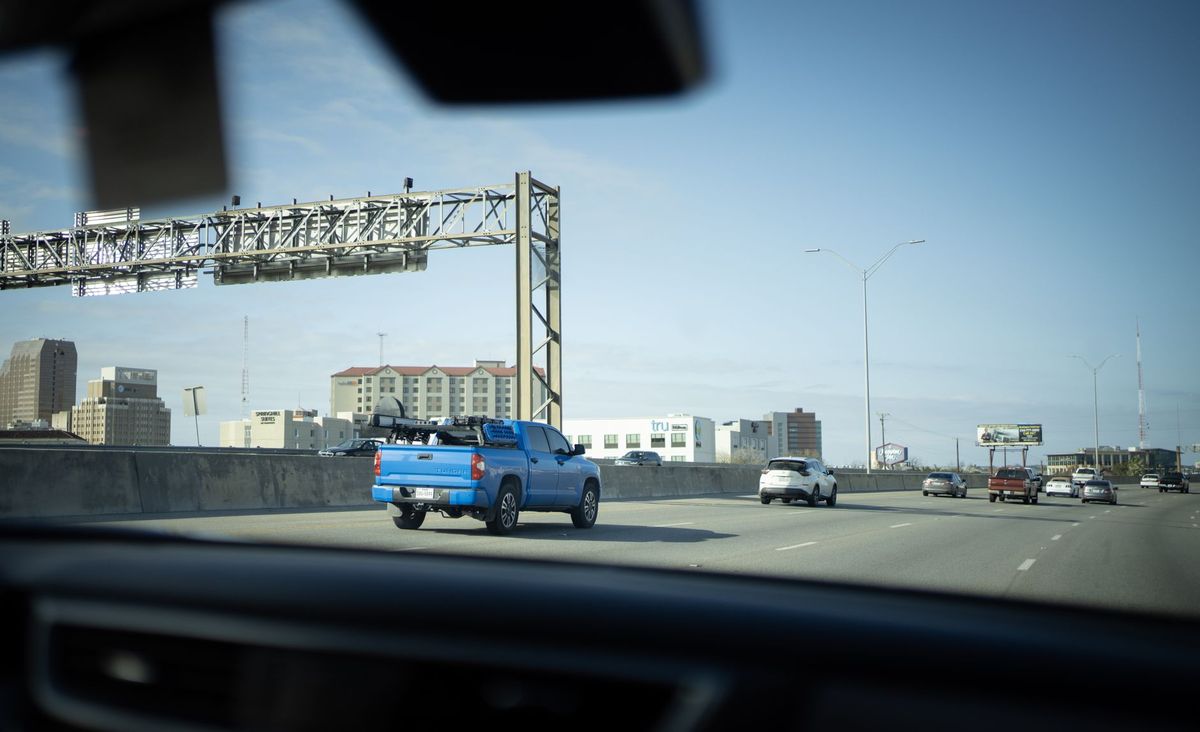
Photo: Pexels