> **Quick Answer:** Limp mode is your car's computer cutting power to prevent engine or transmission damage. You can usually drive slowly to a nearby shop, but do not push it onto a highway or try to drive more than a few miles. Pull over if the engine starts overheating, you smell burning, or the car begins to jerk. Get it diagnosed before you drive it any further than necessary.
## Why Is My Car Stuck at 30 MPH and Won't Go Faster?
Your ECU (engine control unit) detected a fault it considers serious enough to protect the drivetrain, so it triggered limp mode, also called "fail-safe mode." The car deliberately caps RPMs and throttle response, which is why 30 mph feels like a wall. This is not a random glitch. Something real set it off, and the check engine light is almost certainly on.
Common triggers include:
- **Boost pressure faults** on turbocharged engines (a torn intercooler pipe or faulty MAP sensor is one of the most frequent causes)
- **Transmission control module faults**, especially if the car hesitates or slips before limp mode kicks in
- **Throttle body or throttle position sensor failure**
- **Mass airflow (MAF) sensor reading out of range**
- **Overheating** causing the ECU to protect the engine
- A failing **torque converter** on automatic transmissions
A turbocharged engine stuck in limp mode is often something as simple as a cracked boost pipe. You can sometimes hear a hiss under acceleration. Check under the hood for any disconnected or split rubber hoses before you call anyone.
## Can I Drive It or Do I Need a Tow Right Now?
You can drive it short distances at low speed if the engine temperature is normal, there is no burning smell, and the car is not jerking or shuddering. Limp mode is designed to get you off a highway and to a shop, not to take you 40 miles home.
Do not drive it if:
- The temperature gauge is climbing toward the red
- You smell burning rubber or oil
- The car is surging, stalling, or shaking badly
- The transmission is slipping or refusing to shift at all
If any of those apply, you are looking at a tow. Driving through those symptoms risks turning a $300 sensor repair into a [seized engine](/engine-seized-while-driving-need-emergency-tow/) or a destroyed transmission. If the [check engine light is flashing rather than steady](/engine-light-flashing-should-i-pull-over-immediately/), pull over immediately. A flashing light means active misfires are happening and the catalytic converter is at risk.
## What Should I Do Right Now, Before I Call a Mechanic?
First, find a safe place to stop completely. Turn the engine off, wait 60 seconds, and restart. Some limp mode triggers, particularly a temporary sensor spike or a low-voltage event, will clear on restart and the car will drive normally again. If it drives fine after restart, get it to a shop the same day anyway. The fault code is still stored.
If limp mode comes back immediately or does not clear:
1. Do not try to muscle past the speed limiter by flooring the gas. It will not work and you risk overheating.
2. Turn on your hazard lights.
3. If you are on a highway, exit at the next off-ramp. Do not stay on the interstate in limp mode. Other drivers exp
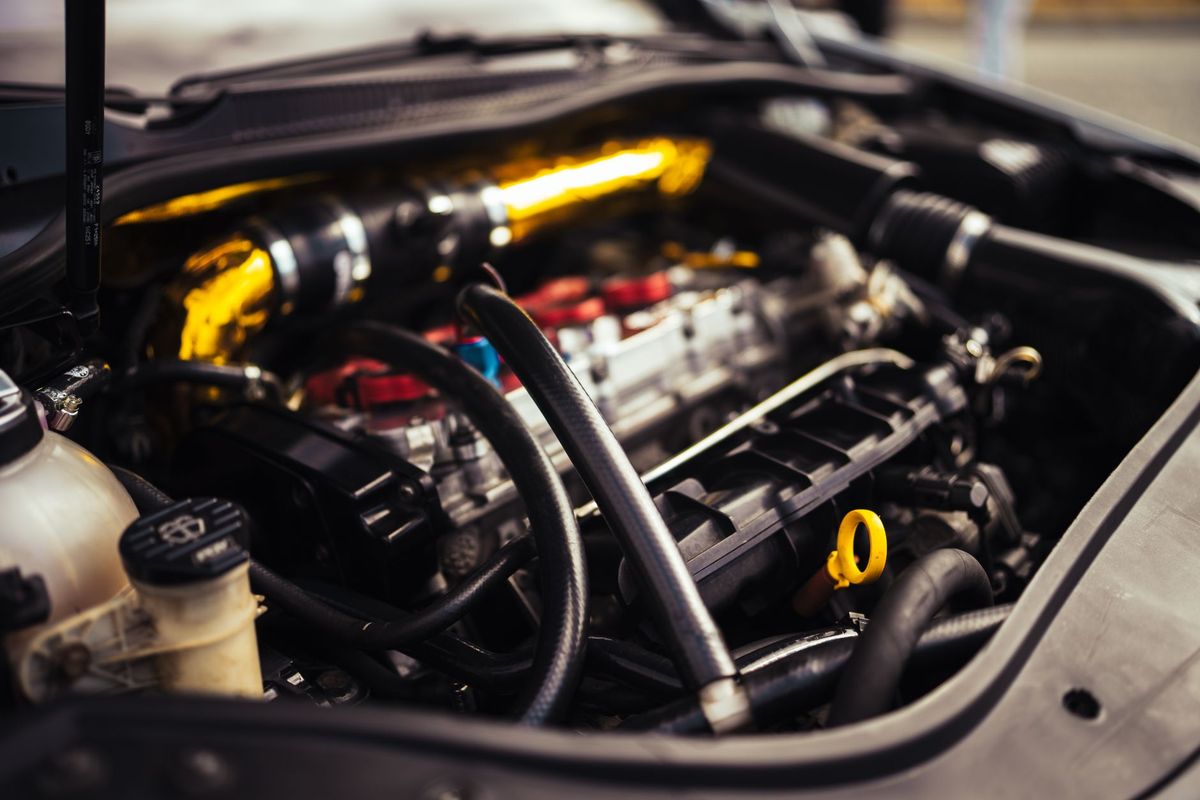
*Photo: Pexels*
ect highway speeds and a car doing 30 mph in traffic is a serious hazard.
4. Call a shop and describe the symptoms. Most shops can give you a rough idea of likely causes over the phone.
5. If you cannot safely reach a shop, call a tow.
If you ended up broken down on a highway before you could exit, check out the steps in [Broken Down on Highway at Night](/broken-down-on-highway-at-night-safety-tips-what-to-do/) for staying safe until help arrives.
## How Do I Know If This Is a Transmission Problem vs. an Engine Problem?
If limp mode kicked in while you were accelerating hard or after the car hesitated and lurched, suspect the transmission first, specifically the transmission control module (TCM) or a solenoid fault. [Transmission issues on the highway](/transmission-failed-on-highway-tow-or-drive-to-shop/) get expensive fast if you keep driving.
If it happened gradually, especially if the car felt sluggish before the cap set in, focus on intake and sensor issues first: MAF sensor, throttle body, or on turbocharged cars, boost leaks.
The only real way to know is an OBD-II scan. Many auto parts stores (AutoZone, O'Reilly, Advance) will read the codes for free while you wait. The fault code, a P-code like P0299 for underboost or P0700 for a transmission control fault, tells you exactly which system triggered limp mode. Do not clear the code before a mechanic sees it.
*Photo: Pexels*
## Common Questions
**Q: Will turning the car off and back on fix limp mode?**
A: Sometimes, yes. If a sensor sent a temporary bad reading, a restart can clear it. But the underlying fault code stays stored in the ECU, and if the trigger was real, limp mode will come back within a few miles. Always get the code read even if the car seems fine after a restart.
**Q: Is it safe to drive on the highway in limp mode?**
A: No. Highway speeds require your engine to operate well above what limp mode allows, and a car capped at 30 mph on an interstate is a collision risk. Exit as soon as you can and stick to surface streets if you drive at all.
**Q: How much does it cost to fix a car stuck in limp mode?**
A: It depends entirely on the cause. A MAF sensor runs $80 to $200 in parts. A boost pipe is often under $50. A throttle body replacement can be $150 to $400. Transmission solenoid repairs start around $300 and can exceed $1,000. Get the code read first before assuming the worst.
**Q: Can low transmission fluid cause limp mode?**
A: Yes. Low or degraded transmission fluid is a direct trigger for limp mode on many automatic transmissions. Check the transmission dipstick if your car has one. If the fluid is dark brown or smells burnt, the fluid itself may be the symptom of a bigger problem, not just the cause.
**Q: My car went into limp mode and now won't start at all. What happened?**
A: If the car stalled out during limp mode and will not restart, the fault has likely progressed beyond a sensor issue. Overheating, a failed fuel pump, or a serious transmission failure can all cause this. At that point you need a tow, not a restart attempt.
---
*Need roadside help? Visit [Tow With The Flow](https://towwiththeflow.com/car-wont-go-over-30-mph-limp-mode/) for real answers when your car breaks down.*
Car Won't Go Over 30 MPH Limp Mode: What's Happening and What to Do
Photo: Pexels